

How to unveil the truth between wrong or real customer caring strategies in the subscription-based industry
Since the moment management doctrine discovered that customers were not just the primary source of revenue, but the stakeholders determining long-term growth and market defensibility, all businesses — explicitly or silently — have placed the client at the center of their agenda. This trend has moved so boldly that today it is almost impossible to find a company that does not declare, “our clients are at the front of our minds and the center of our hearts.”
And yet, apparently, that’s not quite the case. Because if it were, why are call centers so busy handling furious customers, while angry customers post negative reviews that draw the applause of countless followers?
Okay, nobody is perfect — true. Even if you study the best customer care strategy, educate your employees, train your frontline staff, and implement strict customer-safety policies, you may still fall short in taking care of your customers. But while failure can stem from several unexpected or uncontrollable factors (a mistake by a single employee, or, on the other side, the misbehavior of a disloyal customer or an unfair competitor), this analysis aims to address the flaws that stem from a company’s governable management practices.
In this respect, across the infinite range of positions a company can take toward customer excellence, we can describe three types of actors — here is some terminology that may help.
| The Good Communicator | The Good Citizen | The Good Leader |
| customer care is good, but it misses the authenticity | customer care is authentic, but it misses the excellence | customers are centric in the company responsibility |
| Company that treats customer care policies as a marketing strategy, “caring as much as possible” about clients simply to appear as a good stakeholder in the community. | Company that endorses good customer policies in its strategy and pursues genuine customer-care activities but eventually falls short of reaching market leadership. | Company that treats all stakeholders with fair and equal care, using its sincere principles to reach excellence in its approach to customers. |
Evidently, the three categories of companies described are part of a continuum: a Good Citizen is also a Good Communicator, and a Good Leader encompasses all of them. However, as we will see in the following analysis, what drastically distinguishes the first two companies from the Leading organization is the direction in which customer-oriented policies are established: the first two companies build customer relationships on top of their company strategy and operations (a sequence), while the leader derives its customer policies from its value proposition and competitive positioning (a consequence).
Looking more closely, what is the actual difference? The leading organization’s excellence in treating customers stems from its holistic approach to value creation: all stakeholders are in the picture, and the company pursues a broad social responsibility, taking care of employees, suppliers, shareholders, investors, and citizens alongside its customers.
For this analysis, however, we will limit our investigation to the components of an outstanding, authentic customer care strategy. Conversely, examining the performance of these components will reveal whether, behind the scenes, the company is truly leading — or simply acting as a great Communicator or Citizen.
Based on my analysis, to reach excellence in the customer experience — meeting or even surpassing customer expectations throughout their journey alongside the company — four business and management areas must be carefully studied, implemented, and managed: value, transparency, respect, and access. Let’s examine them in more detail.
ELEMENTS IN THE CUSTOMER CARE EXCELLENCE
“Key Customer Excellence Areas”
Questions identifying if a company is building a leadership in its customer relationship strategy
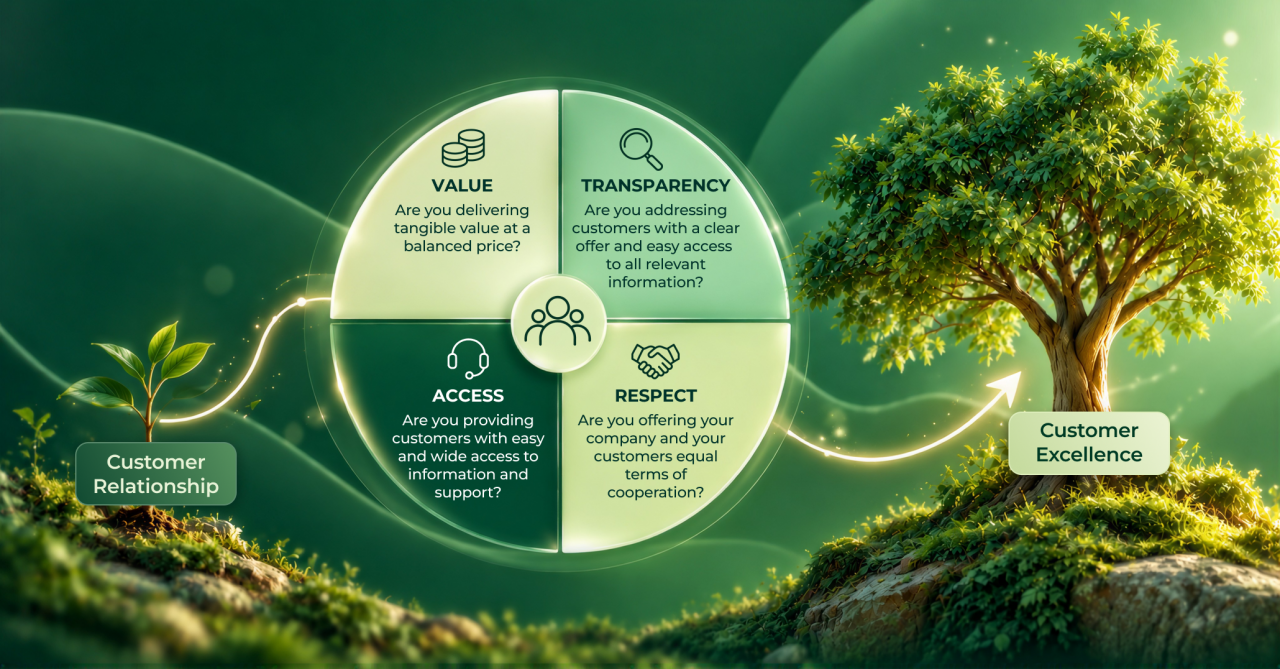
VALUE: Are you delivering tangible value at a balanced price?
As a general rule, a company, to perform well in its market, must deliver (real) value aimed at fulfilling the (real) needs of its customer audience, at a balanced value-to-price ratio. However, managers are often tempted to pursue revenue and profit widening the target to “other (or any) customer segments”. Through marketing techniques, they end up luring in consumers who eventually realize they’ve purchased something unnecessary or of little use, or, in the best-case scenario, something not sold at the right price. Another telling example occurs when a company applies different prices to similar customers, practicing discriminatory policies.
TRANSPARENCY: Are you addressing customers with a clear offer and easy access to all relevant information?
Here, the company is assessed on how it makes information easily available to its customer audience. The concept is broad, ranging from product descriptions to tutorials, from sales terms to pricing, from billing mechanisms to payment systems, and so on. Friendly access to the offering must be carefully designed by the company to secure a safe and easy customer journey, one that also anticipates foreseeable needs in advance.
RESPECT: Are you offering your company and your customers equal terms of cooperation?
In establishing sale and post-sale terms, a company usually has wide latitude to customize the rules that will govern its relationship with prospects and customers. In setting these policies, the context offers an abundance of rules that protect company interests — rules that are justifiable only insofar as they also respect customers’ rights and freedom of choice.
ACCESS: Are you providing customers with easy and wide access to information and support?
A customer must have immediate, independent, and easy access to product or company information: clear purchasing, management, and maintenance terms and regulations must be available and clearly displayed. More precisely, this practice must be in place well in advance — providing clear information on the value proposition during the product or service assessment stage, before adoption or purchase.
The four themes are, evidently, strictly interconnected, and strong policies in one area have a tangible impact on the performance of the other three. By the same principle, if a company underperforms in any of these areas, it becomes impossible to reach excellence in its relationship with customers.
At the same time, while the described model needs to be customized to the industry, the four areas determining the quality of a company’s customer management policies remain the same.
Subscription-based models provide a powerful example, because the enjoyment of the product or service is governed by pre-accepted rules of engagement that often bind customers to rigid terms with reduced capacity to change them.
Applying the model to the customer-challenging market of subscription-based products and services
Well, all of us are consumers, and we all hold multiple running contracts and subscriptions with a vast array of companies across industries such as utilities (telecommunications), media (streaming and broadcasting), financial services (mortgages), or consumer applications. So you will likely recognize, from personal experience, the many occasions on which the companies you were dealing with failed to deliver on their promise.
These direct experiences will further clarify how the model applies to the provider-customer business relationship, and how a company underperforming in one or more of the four areas misses the opportunity to build a strong brand reputation.
Case study listing actions undermining or enhancing customer relationship excellent in the subscription-based industry
CONCLUSIONS
| Area | Don’ts | Do’s |
|---|---|---|
| Value The company must deliver a clear and sincere value proposition, without overselling it. The proposal should fulfill the customer’s real needs. | “7 days trial with credit card (get distracted and we charge you)” “Go premium, pay at the expire date or you get downgraded to the free account (wasting all profile data you entered in the premium registration)” “Enjoy the free account (if you can)” | Deliver “useful” value since day one, even through free subscription Give full freedom of choice to customers in setting the parameters of platform’s use |
| Freemium models must honour their value proposition: let customers enjoy a valuable free account, with meaningful access to the core product. Limitations should be applied to more sophisticated premium features and additional products, not to mainstream functionalities. And where limits are applied by “consumption volume,” they should still guarantee substantial use of the platform.In other words, freemium models should be implemented to deliver real value, ensuring a satisfying experience that convinces customers to want to upgrade. And the timing of that upgrade should be in the customers’ own hands — not dictated by a countdown set by a platform unsure of its own long-term value proposition. | ||
| Trasparency | “What are the platform’s terms (shall I read the 6 Terms of Use pages?)”? “Here your invoice (I have been charged??)” “Sorry you cannot cancel the subscription (if you did not intend to renew, you had to let us know 26 days ago..)” | Clearly displaying, properly summarized, the features belonging to your profile and alternative subscriptions (including the downgraded ones) Let users cancel the subscription anytime with no penalties or unfavorable terms Notify customers, with substantial advance, for upcoming charges or changes in subscription policies |
| Platforms must always be fully transparent about their terms of use, making them accessible and visible to customers and prospects seeking information about the platform. And those same terms should give users full discretion over how, if, and when they use the product. | ||
| Respect | “If you want to downgrade or cancel your subscription, please reach out to our Sales team (if you find the button)” vs “you want to upgrade (great choice, here plenty of options!)?” | Customers shall have clear, transparent backend with all options to manage their subscription level, adding or deleting features, and easily and immediate downgrade or cancellation action buttons Customer data shall be fully protected and not used to tailor opportunistic sales strategies but genuinely used to increase platform’s value and customer experience. |
| It’s basically a “two-way respect” agreement between users and platforms. The latter must always ask themselves: “Do our customers have the same (if not superior) rights, options, and freedom that we do in managing the relationship?” If the answer is yes, equal terms are in place, and so is respect for the audience. | ||
| Access | Ask our bot (“sorry this is not possible”) “Contact us (here the multiple channels, with a long way to get there)” | Platforms shall pay peculiar attention in securing transparent rules and easy and intuitive navigation among options and subscription features. Users must be able to engage or disengage from the subscription anytime, at their solely discretion. |
| Subscription-based ventures, due to the nature of their recurring payment policies, which bind users to specific terms of use, may easily fall into “lock-in” practices. Full freedom of choice must always be granted through intuitive, easy-to-use controls, with full 24/7 independent customer access. | ||
The four-parameter model (Value, Transparency, Respect, Access) provides a solid framework for companies seeking to establish a genuine, added-value relationship with customers, regardless of their industry or product/service. While rules and practices vary according to each business and market context, I believe the solution for managers lies simply in answering the four basic questions highlighted in the chart “Key Customer Excellence Areas.”
Implementing effective solutions in these four areas will create a positive loop, where policies and management practices aimed at delivering excellence in each context reinforce one another, moving the company toward full leadership in how it deals with its customers, and earning it the status of “The Good Leader.”
K.A. Borello


