

Social Purpose as Authentic long-term driver of Individual Business Scopes
Sustainability beyond company borders
In the early stages, forward‑thinking companies striving for a “better world” focused mainly on reducing their environmental impact, supporting local communities, and safeguarding employees’ wellbeing. These were all positive initiatives, typically framed as goal-oriented management practices.
Over time, as understanding grew about the broader role of companies in society, the social dimension of business was gradually elevated to the same level as its commercial mission, leading to the emergence of the management doctrine of Corporate Social Responsibility (CSR).
Following research into how companies affect society concentrated further attention on three key management practices shaping business overall impact: implementing environmentally friendly actions, developing robust social policies, and ensuring sound governance. As a result, numerous agencies and organizations rapidly created regulations and standards around these three dimensions to assess and compare “corporate goodness,” now commonly reflected in Environmental, Social, and Governance (ESG) ratings.
However, while the framework worked well over the years for its guidelines on sustainable performance, researchers encountered major challenges in defining regulations and promoting change beyond company boundaries. From both theoretical and practical perspectives, shifting from a management-level approach to an ecosystem-level approach proved to be much more challenging.
To minimize environmental impact and enhance community wellbeing across society and business ecosystems, shared rules, common practices, and coordinated efforts among companies and external stakeholders are essential.
In this context, the transformation of goods—from raw materials to finished products—and their distribution among manufacturers, distributors, and customers play a crucial role. In other words, supply chain and commercial operations are at the heart of sustainable ecosystems.
The following chart, while simplifying the network of actors involved, shows how social and environmental goals are deeply connected to supply chains. It highlights the interconnection of its actors, from manufacturers and customers, often mediated by multiple intermediaries acting as buyers and sellers (distributors) that bring products to market, all supported by financing institutions (creditors) and specialized service providers such as shipping companies and customs brokers.
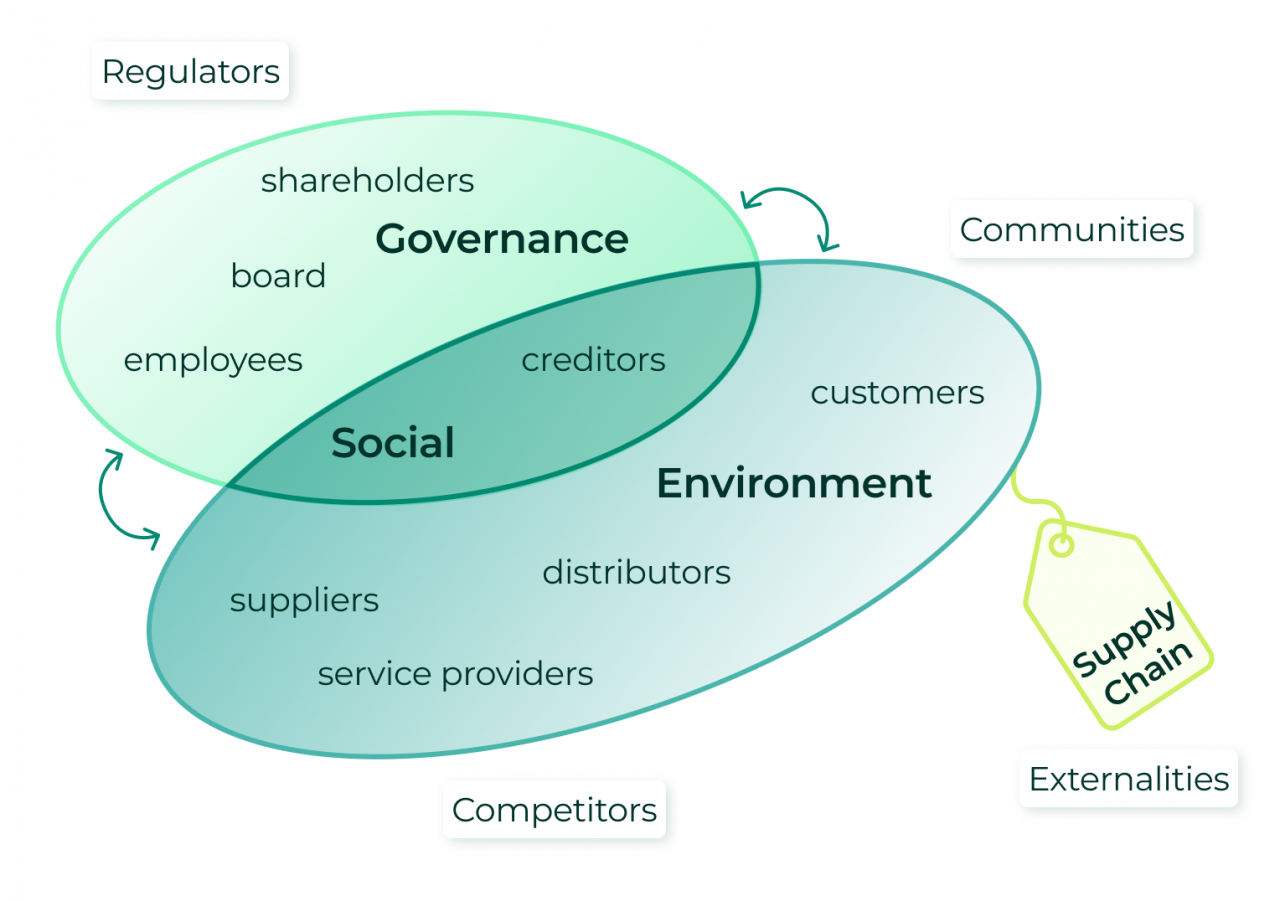
Business scope in company trade
What are the scopes for a (for-profit) company? Growth, profits, stakeholders’ satisfaction. The company can pursue these goals within a narrower or broader circle of actors. If narrow, often it is focused on internal stakeholders such as shareholders and employees, or, if part of the value proposition and competitive strategy, altogether to “external” actors, such customers. However, in the supply chain, the picture is usually different: here the competition is fierce, and players try to ”catch” the highest value possible negotiating, competing or even bypassing each other. The ultimate goal is to reach a supply chain control, tightening the relationship with the source (materials) and extending the presence to the market (end customers) either by physical distribution or brand positioning. Such positioning secure apparently stability, value and higher competitive margins.
On some occasions, it is altogether true that, while the single company behavior can be tied to its management style and goals, sometimes it is greatly influenced by ”Industry norms”, when the majority of players apply “standard practices” which are not necessary adherent to transparent and fair business terms. However, even in this case, the company is not “obliged” to flatten its corporate values to mediocre competitor or partners’ behavior.
So, what is the outcome of such individualistic business scope? Buyers and Sellers (and Service Providers) along the supply chain compete trying to maximize returns, leveraging market position, demand/supply balance, cross-border regulations, distant and opaque communication and cultural barriers. Being B2B trade complex, it is easier to apply less transparent or opportunistic practices. At the same time, it is undeniable that such behavior is short-sighted, because it ends up in shorter-term cooperations, reduced quality (product / service), unstable commerce flows, and riskier compliance operations.
Impact in supply chains
With this business perspective in mind, we must recognize that, in general, the impact of any single company’s more or less sustainable actions is diluted within the wider ecosystem, because what truly determines overall outcomes is the collective behaviour of all actors in the supply chain.
Aside from large corporations that internalize multiple stages of production and distribution through vertically integrated supply chains, most companies occupy only one position within a broader material and process flow, for example:
Extraction Company > Trading Company > Manufacturing Company > Third-party assembler > Shipping company > Importer > Distributor > Retailer > End Customer
These boundaries work in both directions: they can limit the positive effects of a single player’s “good business and social” actions, but they can also contain or buffer “bad” practices. While this is undeniable, it is equally true that:
- Every single action matters. The benefits that businesses bring to society are the sum of actions taken by individual companies; therefore, any “good” company should stand by this principle, setting a positive example for others and encouraging the adoption of best sustainable practices to enhance the shared, responsible well-being of the surrounding ecosystem.
- The good (or bad) practices of a single company can have an amplified effect throughout the supply chain and, to varying degrees, create a domino effect that escalates their impact. For example, when a company delays payments to a supplier, it may cause that partner to postpone its own payments to other companies, resulting in a cascading negative effect across a broader corporate network.
Social purpose in a commerce ecosystem
It is clrear that fair and sustainable practices are essential ingredients for the long-term commercial success of a company and, by direct consequence, of entire supply-chain ecosystems, for multiple reasons, such as:
- designing a well-conceived product helps prevent costly regulatory adjustments at later stages;
- engineering a compact, easy-to-assemble product creates significant shipping efficiencies;1
- establishing transparent and fair terms with business partners helps build long-term, durable relationships;
- providing tangible value across the supply chain creates clear and well-recognized market positioning and strengthens brand reputation;
- etc;
However, as we have seen, a company—whether by choice, lack of knowledge, or compliance with industry malpractices—may pursue opportunistic market strategies that threaten the “health” of the entire sustainable supply chain. In doing so, it risks undermining its own long-term success, damaging its market reputation, and compromising its broader community purpose. This raises a critical question for management: what is the path forward to align business objectives with an overarching social mission?
So, how can trade be made fair, sustainable, and aligned with the long-term well-being and success of its actors? The following figure presents a comprehensive framework highlighting the factors that sellers can leverage to successfully close deals with buyers while securing a positive product lifecycle.
The answer lies within this framework: while focusing on one or a few of these factors may help a company win a competitive deal and strengthen its commercial performance (business scope), pursuing all of them together enables the company to achieve altogether its broader social purpose.
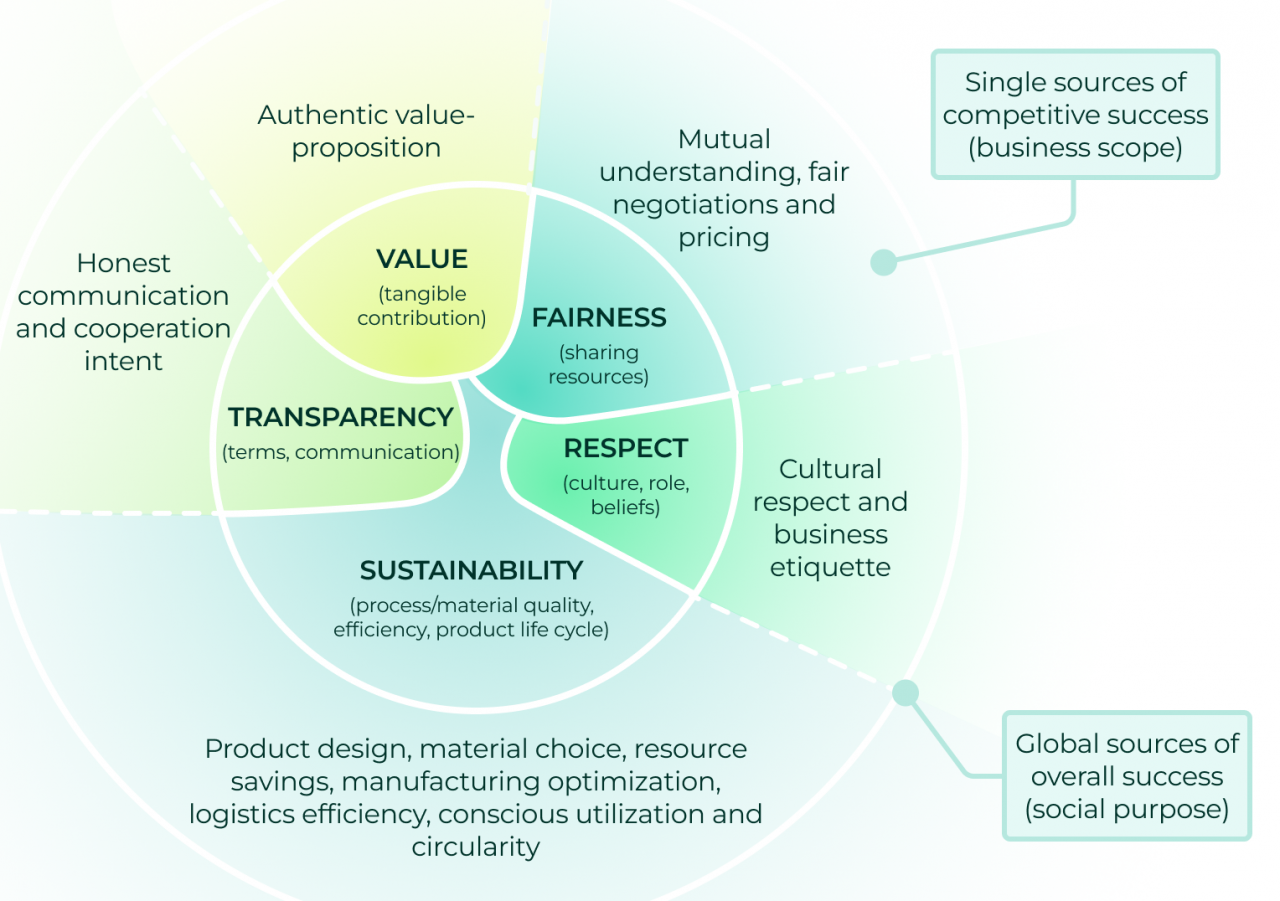
How scope & purpose are actually aligned
Starting from the premise that the well-being of the supply chain derives from the good practices of its actors, and that a healthy supply chain provides companies with a solid position that protects their commercial competitiveness, we can now turn our attention to what each company should do to achieve this ultimate goal.
The answer lies in adopting a broader perspective—one that takes into account the interests of all company stakeholders, and more specifically, those of supply-chain stakeholders, which are central to sustainable
and successful commerce.
This approach is based on reciprocal respect and shared goals among ecosystem actors, a concept that some researchers describe as “systems thinking,”2 in contrast to the narrower and more traditional “business thinking.” Under this approach, a company evaluates its actions by considering their impact on both direct and indirect stakeholders, assessing not only immediate business gains but the overall balance of trade-offs within the broader business and social context.
In traditional negotiation theory, participants primarily pursue their own goals and interests, interacting with others to maximize individual returns. Even in balanced and respectful negotiations, compromises among competing interests are often necessary. By contrast, a systems-based approach seeks to align participants’ interests from the outset, reducing the need for compromise and discouraging individualistic behavior. In this sense, the very notion of “compromise among stakeholders” reflects a short-sighted business perspective—one that can be significantly reduced, if not avoided altogether, through this more integrated and forward-looking approach.
| Successful Factors | Business Success | Social Purpose | |
| VALUE (tangible contribution) | Authentic value-proposition offered by sellers, resellers and service providers along the supply chain. For a healthy supply chain, each actor must deliver product/service adding tangible value in the interaction with the other participants. | X | X |
| FAIRNESS (sharing resources) | Negotiating parties take counterparts needs as anchor points in defining the terms of the agreement. Mutual understanding, fair negotiations and pricing3 are key elements to reach a fair and valuable deal. | X | X |
| TRANSPARENCY (terms, communication) | Parties, while enhancing their value proposition, shall maintain the tones of honest communication, presenting transparent identity and highlighting limits and application boundaries of their offer. The overall intent is to maximize the cooperation intent and reach a deal only if “add authentic value” for all parties involved. | X | X |
| SUSTAINABILITY (process/material quality, efficiency, product life cycle) | Sellers shall “create highly sustainable products” since their concept (design, materials, manufacturing impact) seeking process and transformation optimization. Then all actors shall secure logistics efficiency, information flow, training to maximize conscious utilization and product circularity. | X | X |
| RESPECT (culture, role, benefits) | Cultural respect, awareness and adherence to social norms and effective business etiquette are proactively and sincerely endorsed by the parties with the willingness to establish a fruitful long-term relationship beyond any short-term goal. | X | X |
Conclusion
Many paths can lead to long-term business success, sometimes beyond what traditional management theories explain. However, most enduring successes are built on objective and relational factors such as exchanged value, transparent negotiation, and balanced cooperation that enable win–win outcomes. This analysis focuses on these elements, offering a practical framework to help companies achieve a healthy and sustainable position within their markets and supply chains. Third-party actors—such as regulators, industry associations, government agencies, marketplaces, and large supply-chain leaders—play an important role in promoting fair trade practices and meaningful commercial relationships.
Ultimately, achieving a positive alignment between business and social objectives requires a shift in entrepreneurial mindset toward value creation, partner respect, fair competition, and shared value. Embracing the principles of value, respect, transparency, fairness, and sustainability enables a strategy for long-term success.
K.A. Borello
1. In the example, building an eco-friendly, safe and recyclable product minimizes risks of modifications, adaptations to compliant features.
2. As described in “Why You Need Systems Thinking Now”, HBR September-October 2025.
3. The Power of Fair Pricing, K.A Borello.


